I find one of the most impactful ways to engage the public in science content is by inspiring curiosity. So when choosing which research results or projects to highlight, I often chose those that are odd, unusual, fun, or sensory. These stories may not always showcase the most important science results, but they serve as a gateway to exploration: they open the door for a reader or viewer to want to learn more.
Ghostly sounds of a vibrating Antarctic Ice Shelf
A 2018 research paper found winds blowing across the Ross Ice Shelf cause the ice surface to vibrate, producing a near-constant seismic hum. One of the paper’s authors sped up a recording of these vibrations so they could be heard by human ears, and the resulting sounds are positively creepy. I wrote a press release to highlight this work and created a video showcasing the unusual audio. The video went viral; it garnered over 1 million views on YouTube and was featured on The Late Show with Stephen Colbert several days later.
A Cold War decision resurfaces
A 2016 study found climate change could remobilize hazardous waste thought to be buried forever beneath the Greenland Ice Sheet.
The U.S. military built a top-secret base within the Greenland Ice Sheet in 1959 to test the feasibility of deploying nuclear missiles from the Arctic during the Cold War. When Camp Century was decommissioned in 1967, its infrastructure and hazardous waste were abandoned under the assumption they would be entombed forever by perpetual snowfall. But researchers analyzing climate warming projections determined the waste could someday thaw and contaminate the Arctic environment.
I chose to highlight this story because so many aspects of it fascinated me: the concept of building a military base under a moving ice sheet, the top-secret nature of the remote Arctic camp, the fact that the base was abandoned after only a decade, and the potential geopolitical issues that could arise if the waste does eventually surface. To me, it read like a James Bond movie. I wrote a press release to publicize this work, highlighting how this study identifies a hole in existing international law: the law is clear about who should take responsibility for preventing future waste spills but ambiguous about who is liable for waste that has already been discarded.
The story generated a media frenzy: it was picked up by nearly 300 news outlets in August 2016 and resulted in Greenland’s local leaders calling on Denmark to clean up the waste.
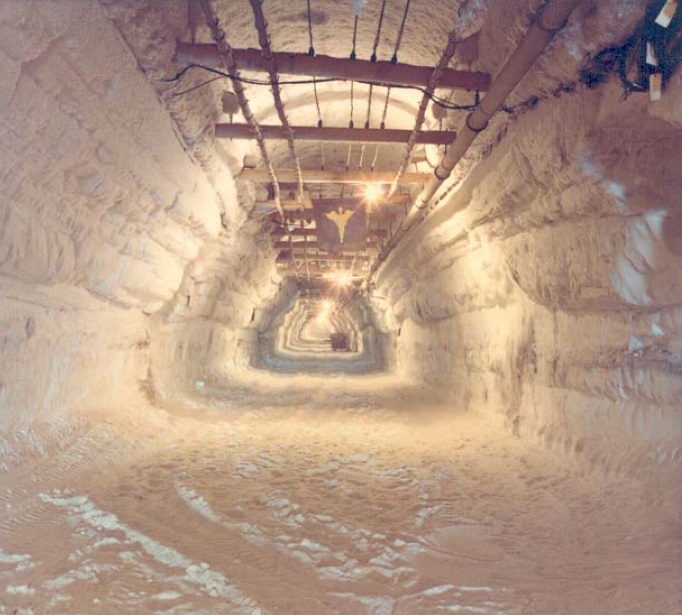
A view inside the main 400-meter access trench to Camp Century in 1964.
Credit: US Army.
Speaking volcano language
A 2018 study found Ecuador’s Cotopaxi volcano produces unique sounds scientists hadn’t heard coming from a volcano before. I chose to highlight this study because of its sensory angle and the fact that there were metaphors readily available to describe the volcano’s sonic activity.
This particular volcano has a crater shaped like a long cylinder, which scientists liken to an enormous pipe organ. The sound waves Cotopaxi produces oscillate back and forth while diminishing over time, so the lead researcher on this study compared it to classic old Western saloon doors that once opened, swing back and forth several times before coming to rest. The saloon door and pipe organ metaphors provided imagery that helped illustrate the unusual audio. In addition to writing a press release about this study, I combined audio recordings of the volcano’s sounds with breathtaking photos of Cotopaxi to share the results in a video format so they could easily be shared on the web and social media.
 Lauren Lipuma